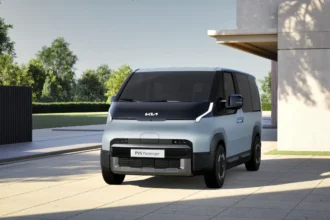
The automotive world is full of concept cars that promise the future but only a handful genuinely feel like they could reshape how we think about mobility. The Kia HabaNiro is one of those rare creations. First revealed at the New York International Auto Show, this bold electric crossover didn’t just showcase design flair; it introduced a new category altogether an “everything car” built to adapt seamlessly to daily life, adventure, and autonomous driving.
Rather than being a distant fantasy, the HabaNiro reads like a blueprint for where Kia is heading. If you look closely at modern Kia EVs, you can already spot echoes of its influence.
A Fresh Take on the “Everything Car” Concept
Kia’s vision here wasn’t to create just another electric SUV. The idea was to blur boundaries city commuter, off-road explorer, tech hub, and lifestyle vehicle all rolled into one. That’s why the HabaNiro sits somewhere between a compact crossover and a futuristic mobility platform.
Its proportions are tight yet muscular, with short overhangs and a planted stance that suggests capability beyond paved roads. At the same time, its aerodynamic shaping and EV architecture signal efficiency and range readiness.
This dual personality is what makes it compelling. Most vehicles force you to choose between practicality and excitement. The HabaNiro quietly suggests you don’t have to.
Exterior Design That Breaks Convention
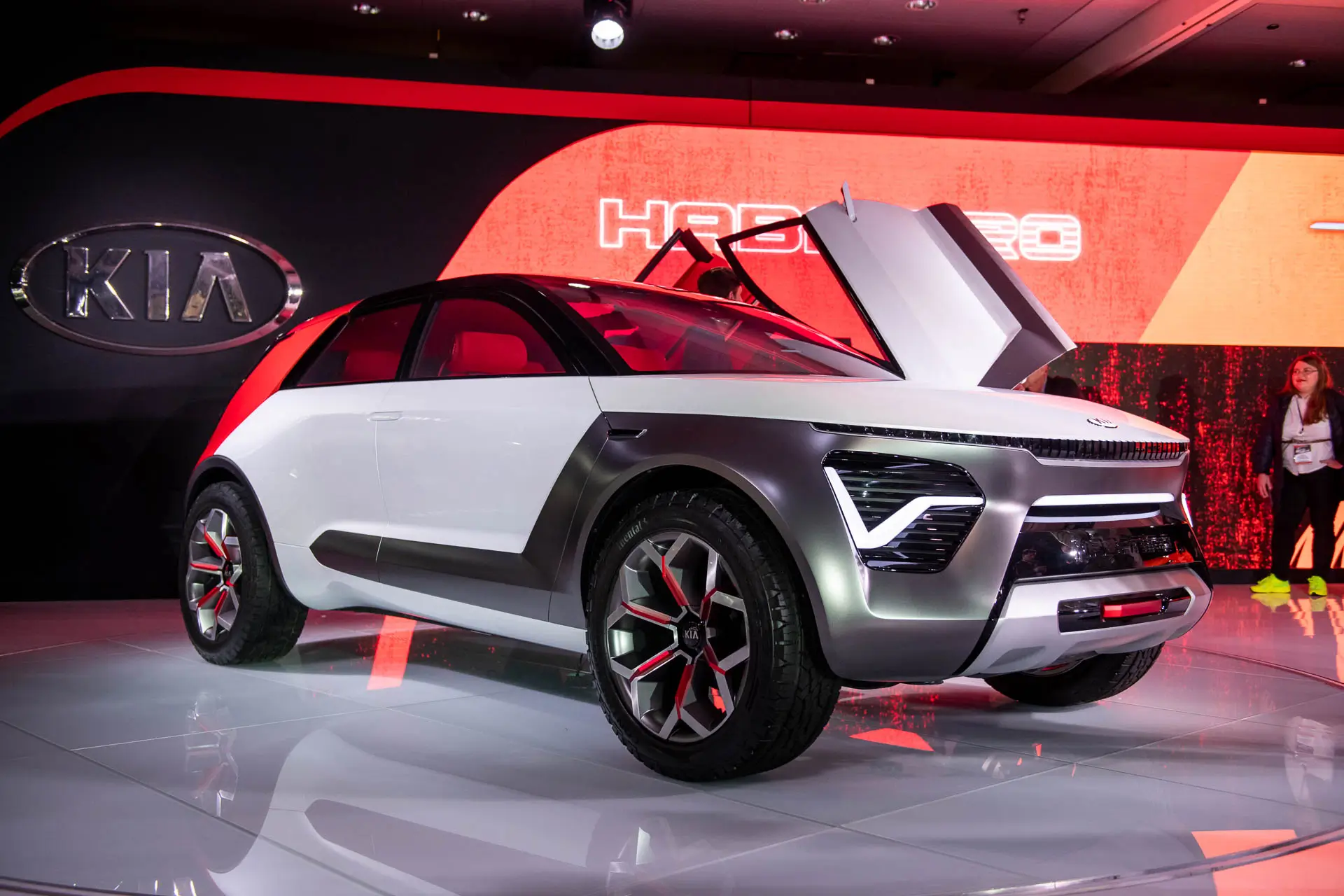
Visually, the HabaNiro is unmistakable. The contrast between its metallic gray cladding and vibrant Lava Red aero panel creates a dynamic, almost kinetic appearance even when standing still.
Key highlights include:
- Butterfly-wing doors that open dramatically upward
- A shark-inspired front fascia with aluminum “teeth” detailing
- Camera-based mirrors replacing traditional side mirrors
- 20-inch wheels paired with rugged proportions
It’s aggressive without being overdone. Futuristic, yet grounded in purpose. While features like butterfly doors may not reach production anytime soon, the design language sharp lines, bold lighting signatures, and confident stance has already influenced newer Kia EVs.
Interior: A Digital Lounge on Wheels
Step inside, and the HabaNiro feels less like a car and more like an interactive environment. Gone are traditional screens and buttons. Instead, a full-width head-up display stretches across the windshield, delivering everything from navigation to entertainment.
The cabin is defined by:
- A concave acrylic touch interface replacing conventional dashboards
- A perimeter ventilation system distributing airflow evenly
- Floating seats wrapped in textured fabric
- Ambient lighting that adapts to mood and setting
One particularly striking feature is how the interior transforms in autonomous mode. When self-driving is engaged, the steering wheel retracts, opening up space and turning the cabin into a lounge-like setting.
I remember sitting in a similar concept vehicle at an auto show once, and the absence of physical controls felt strange at first but within minutes, it became clear how intuitive and immersive that environment could be.
Electric Powertrain and Performance Vision
Although it’s a concept, the HabaNiro’s performance targets are realistic enough to matter. Kia envisioned:
- Dual electric motors enabling all-wheel drive
- A driving range exceeding 300 miles
- Advanced battery technology for efficiency and durability
These figures align closely with today’s premium EV benchmarks, which reinforces the idea that the HabaNiro wasn’t مجرد experimentation—it was forward planning.
The AWD setup also hints at versatility. Whether navigating urban streets or heading off the beaten path, the vehicle is designed to adapt without compromise.
AI and Emotional Intelligence Inside the Cabin
Where the HabaNiro truly separates itself is in its use of artificial intelligence. Kia introduced the R.E.A.D. (Real-time Emotion Adaptive Driving) system, which monitors the driver’s emotional state using biometric sensors.
This system can:
- Adjust lighting, temperature, and music based on mood
- Enhance comfort during stressful driving conditions
- Improve safety by responding to fatigue or distraction
Combined with the Eye Tracking System, the car can even detect when you glance toward the rearview area and instantly display a 180-degree video feed.
This isn’t just convenience—it’s a shift toward cars that understand and respond to human behavior.
Autonomous Driving: A Glimpse of Level 5
The HabaNiro also embraces Level 5 autonomy, meaning full self-driving capability without human intervention. While this level of autonomy isn’t yet widely available, the concept demonstrates how the interior and user experience could evolve once it becomes reality.
In practical terms, imagine:
You’re commuting through heavy traffic after a long workday. Instead of gripping the wheel, you switch to autonomous mode. The cabin adjusts lighting to a calming tone, plays your preferred playlist, and transforms into a relaxation space while the car handles the drive.
That’s the kind of real-world scenario the HabaNiro is built around not just getting from point A to B, but redefining what happens in between.
How It Stacks Up Against Other Electric Concepts
To better understand its position, it helps to compare it with other forward-thinking electric vehicles:
| Feature | Kia HabaNiro | Tesla Model Y | Hyundai Ioniq 5 |
|---|---|---|---|
| Powertrain | Dual-motor AWD | Dual/Single motor | Dual/Single motor |
| Range | 300+ miles (target) | ~330 miles | ~300 miles |
| Autonomy | Level 5 (concept) | Advanced driver assist | Level 2 autonomy |
| Interior Tech | Full HUD, AI-based | Minimalist touchscreen | Dual-screen digital |
| Unique Element | Emotion AI + butterfly doors | OTA ecosystem | Retro-futuristic design |
What stands out is that while competitors focus on refinement and incremental innovation, the HabaNiro pushes boundaries—especially in AI integration and user experience.
Why the HabaNiro Still Matters Today
Even years after its debut, the HabaNiro remains relevant. Many of its ideas are gradually appearing in production vehicles:
- Larger, more immersive displays
- Advanced driver monitoring systems
- Increasing levels of automation
- Design language inspired by bold concept styling
Kia has already proven with vehicles like the Kia EV6 and Kia EV9 that concept ideas can evolve into reality faster than expected.
The HabaNiro serves as a creative benchmark a reminder that innovation doesn’t have to be incremental.
Related: Kia GT4 Stinger Overview
Conclusion
The Kia HabaNiro isn’t just a concept car, it’s a statement about where mobility is headed. It challenges traditional categories, redefines in-car technology, and introduces a human-centric approach to driving through AI and emotional awareness.
While not every feature will reach production in its original form, the underlying philosophy is already shaping the next generation of vehicles. For anyone interested in the future of electric mobility, the HabaNiro is less about speculation and more about direction.
FAQs
Is the Kia HabaNiro available for purchase?
No, it remains a concept vehicle and is not currently in production.
What makes the HabaNiro different from other electric SUVs?
Its focus on AI-driven personalization, emotional recognition, and full autonomy sets it apart from conventional EVs.
What is the expected driving range?
Kia projected a range of over 300 miles on a single charge.
Will any features from the HabaNiro appear in future Kia models?
Yes, elements like design cues, advanced displays, and driver-assist technologies are already influencing newer Kia EVs.
What does “everything car” mean?
It refers to a vehicle designed to handle multiple roles—commuting, adventure, technology hub, and autonomous mobility all in one platform.