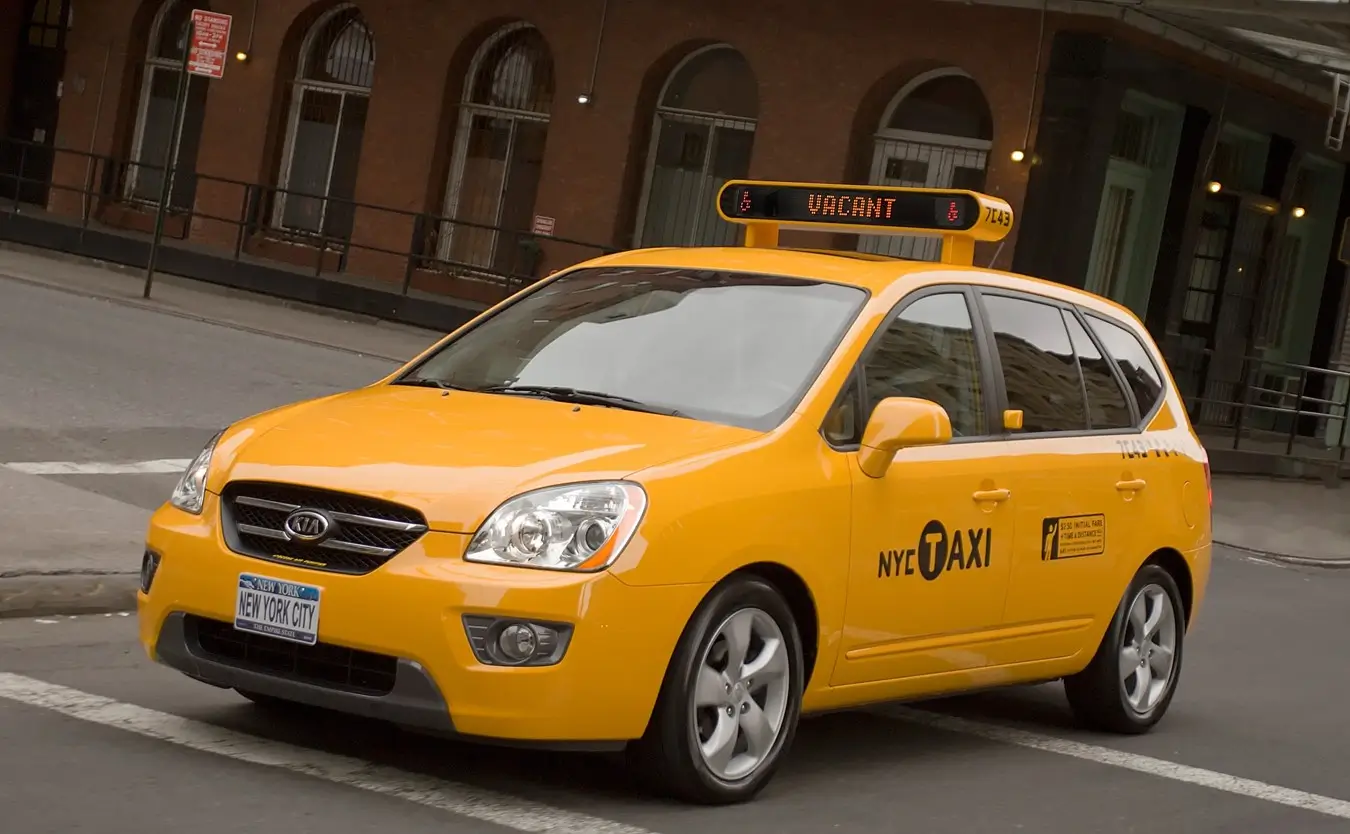
Urban transportation has always demanded vehicles that balance passenger comfort, durability, accessibility, and operating efficiency. Long before purpose-built electric taxis became a global trend, Kia introduced a creative solution that challenged conventional taxi design. The Kia Rondo Taxi was not a production model but a forward-thinking concept developed for New York City’s famous Taxi ’07 Design Challenge, demonstrating how a compact multi-purpose vehicle could better serve both passengers and drivers.
Unlike traditional yellow cabs of its era, the Rondo Taxi focused on inclusivity, practicality, and lower operating costs. Although it never entered mass production, many of its ideas anticipated features that later became common in modern ride-hailing and taxi services.
In this Kia Rondo Taxi Overview, we’ll explore its design philosophy, standout features, passenger-focused innovations, and why this concept remains one of Kia’s most interesting transportation experiments.
Why Kia Created the Rondo Taxi Concept
During the mid-2000s, New York City sought proposals for a safer, cleaner, and more practical taxi. Manufacturers worldwide were invited to rethink what a city taxi should be.
Kia responded by transforming the first-generation Kia Rondo crossover into a vehicle specifically tailored for urban commercial transportation rather than adapting a traditional sedan.
Instead of simply repainting an existing vehicle yellow, Kia redesigned the cabin to address everyday challenges faced by drivers, passengers, and fleet operators.
Its objectives included:
- Better accessibility
- Easier maintenance
- Improved passenger comfort
- Enhanced driver protection
- Practical technology integration
- Efficient use of interior space
Even today, these priorities remain central to taxi fleet development worldwide.
Exterior Designed for Busy City Streets
The Rondo’s compact dimensions made it particularly suitable for crowded metropolitan environments.
Its relatively short overall length allowed drivers to navigate narrow streets while maintaining generous passenger space inside. The tall roofline improved headroom, making entry and exit easier for riders of all ages.
Large side doors also simplified boarding, especially for elderly passengers and families travelling with luggage.
The concept featured styling cues associated with New York taxis while maintaining Kia’s recognizable crossover proportions.
Unlike oversized vans, the Rondo balanced manoeuvrability with interior practicality—an important consideration in heavy urban traffic.
A Cabin Built for High-Demand Commercial Use
One of the concept’s biggest strengths was its thoughtfully designed interior.
Rather than using premium materials that could wear quickly under constant commercial use, Kia selected surfaces specifically intended for durability.
Key interior features included:
- Waterproof UltraLeather seating
- Easy-to-clean vinyl flooring
- Stain-resistant materials
- Spacious rear seating
- Excellent visibility
- Large cargo area
These materials reduced cleaning time while helping the vehicle maintain a professional appearance throughout long operating hours.
From my perspective after studying numerous commercial vehicle concepts, the Rondo Taxi stands out because it prioritised everyday usability over flashy design, making it feel surprisingly realistic for fleet service.
Accessibility Was One of Its Greatest Innovations
Perhaps the most impressive aspect of the Kia Rondo Taxi was its commitment to accessibility.
Instead of treating mobility assistance as an optional feature, Kia integrated it directly into the vehicle’s design.
A Bruno motorized sliding front passenger seat helped riders with limited mobility enter and exit more comfortably.
This feature reduced physical strain for both passengers and drivers while making transportation more inclusive.
Accessibility was becoming an increasingly important requirement for public transportation, and Kia demonstrated a practical solution years before similar ideas became more common.
Driver Safety Received Equal Attention
Taxi drivers spend countless hours interacting with strangers, making personal safety an important consideration.
The Rondo Taxi introduced an L-shaped transparent driver partition that provided protection without creating a completely isolated cabin.
Compared with traditional metal barriers, the clear partition maintained better communication between passengers and drivers while improving security.
The concept also included:
- Better visibility
- Comfortable driving position
- Simplified cabin layout
- Convenient access to controls
These thoughtful improvements showed that commercial vehicles should protect drivers without sacrificing usability.
Passenger Technology That Looked Ahead
Although introduced nearly two decades ago, the Rondo Taxi envisioned technology that resembles today’s connected transportation services.
Passengers were expected to interact with an onboard touchscreen system capable of delivering:
- Route information
- Passenger services
- Entertainment options
- Digital advertising
- Travel information
At a time when smartphones were still in their infancy, this represented an ambitious vision of connected urban transportation.
Today, many ride-sharing vehicles and modern taxis incorporate similar digital features, making Kia’s concept appear remarkably forward-thinking.
Practical Safety Features for Everyday Families
The Rondo Taxi wasn’t designed solely for business travellers.
Recognising that taxis regularly transport families, Kia integrated a built-in child safety seat directly into the vehicle.
This eliminated one of the biggest challenges parents often face when travelling by taxi.
Combined with its spacious interior and easy entry height, the vehicle offered a family-friendly transportation solution that many traditional sedans struggled to match.
How the Kia Rondo Taxi Compared with Traditional NYC Taxis
| Feature | Kia Rondo Taxi Concept | Traditional NYC Sedan Taxi (2007 Era) |
|---|---|---|
| Vehicle Type | Compact MPV/Crossover | Full-size Sedan |
| Passenger Accessibility | Excellent | Limited |
| Wheelchair Assistance | Motorized passenger seat | Minimal |
| Interior Materials | Waterproof and washable | Standard upholstery |
| Driver Protection | Transparent partition | Conventional barrier |
| Child Safety Seat | Integrated | Usually unavailable |
| Passenger Technology | Touchscreen information system | Basic meter only |
| Cargo Flexibility | High | Moderate |
| Urban Maneuverability | Excellent | Good |
This comparison illustrates how Kia wasn’t merely redesigning a taxi, it was rethinking the passenger experience from the ground up.
What Made This Concept Different
Many concept vehicles showcase futuristic styling that rarely reaches production.
The Kia Rondo Taxi followed a different philosophy.
Nearly every major feature addressed an everyday operational challenge:
- Faster cabin cleaning
- Improved accessibility
- Better passenger comfort
- Enhanced driver security
- Lower maintenance effort
- Family-friendly travel
- More efficient urban mobility
That practical mindset is what continues to make this concept relevant today. Rather than chasing dramatic styling trends, Kia proposed solutions that could genuinely improve daily taxi operations, creating a concept whose ideas have aged remarkably well.
An Example of Everyday Urban Service
Imagine a busy weekday morning in Manhattan.
A taxi driver first picks up an elderly passenger heading to a medical appointment. The motorized passenger seat makes boarding easier without requiring additional assistance.
Minutes later, the next fare is a family travelling to the airport. The integrated child safety seat eliminates the need for parents to carry extra equipment, while the spacious cargo area accommodates several suitcases.
Later in the afternoon, a commuter carrying groceries benefits from the low step-in height and wide-opening doors, while the wipe-clean interior allows the driver to quickly prepare for the next passenger after a rainy day.
This flexibility demonstrates how one thoughtfully designed vehicle could comfortably serve a wide variety of passengers throughout a single workday.
Why the Kia Rondo Taxi Never Reached Production
Although the concept received attention during the Taxi ’07 competition, it remained a design proposal rather than a production vehicle.
Several factors contributed to this outcome:
- New York City’s final taxi selection followed a different procurement process.
- Commercial fleet economics evolved over time.
- Manufacturers shifted toward newer platforms and technologies.
- Hybrid and electric vehicles later became the primary focus for urban taxi fleets.
Nevertheless, many of the ideas introduced by the Rondo Taxi accessibility, durable interiors, connected passenger technology, and user-focused design have since become important priorities across the transportation industry.
Related: Kia Rondo SX Overview
Conclusion
The Kia Rondo Taxi represents one of Kia’s most practical and people-focused concept vehicles. Rather than emphasising performance or futuristic styling alone, it tackled real challenges faced by passengers, drivers, and fleet operators. Features such as waterproof seating, mobility-friendly access, integrated child safety solutions, and onboard passenger technology demonstrated a thoughtful approach to urban transportation that was ahead of its time.
Although it never entered production, the concept showcased Kia’s ability to think beyond conventional vehicle categories. Looking back today, many of its innovations align closely with the expectations people now have for modern taxis and ride-sharing services, proving that good ideas often influence the future even when they never reach the showroom.
FAQs
Was the Kia Rondo Taxi ever sold to the public?
No. It was developed as a concept vehicle for New York City’s Taxi ’07 Design Challenge and never entered commercial production.
What made the Kia Rondo Taxi unique?
Its emphasis on accessibility, durable waterproof materials, integrated child safety seating, driver protection, and passenger-focused technology distinguished it from conventional taxi designs of its time.
Was the Kia Rondo Taxi wheelchair accessible?
While it was not a fully wheelchair-converted vehicle, it featured a Bruno motorized sliding front passenger seat that significantly improved access for passengers with limited mobility.
Did the Kia Rondo Taxi use a special engine?
No. The concept was based on the first-generation Kia Rondo platform, with the primary innovations centred on interior design, accessibility, and commercial functionality rather than a unique powertrain.
Why is the Kia Rondo Taxi still discussed today?
It introduced several practical ideas such as easy-clean interiors, inclusive passenger access, and connected in-cabin technology that anticipated many features now found in modern taxi and ride-hailing vehicles.