When people discuss Kia’s most influential concept vehicles, models like the EV concepts and performance studies often receive the spotlight. However, one of the brand’s most fascinating experiments arrived in 2010 in the form of the Kia Pop—a compact electric concept that challenged conventional thinking about city transportation.
Unveiled at the 2010 Paris Motor Show, the Pop represented a bold vision of how urban mobility could evolve in an increasingly crowded and environmentally conscious world. Measuring just three meters in length, this futuristic three-seat electric vehicle combined unconventional styling, innovative packaging, and zero-emission driving into a remarkably compact package.
Although it never entered production, the concept demonstrated ideas that would later become increasingly relevant as electric city cars gained popularity across global markets.
What Was the Kia Pop?
The Kia Pop was a fully electric concept car developed by Kia’s European design team as an exploration of future urban transportation. Unlike traditional compact cars that simply reduced dimensions, this project reimagined how people might travel efficiently in dense metropolitan environments.
The vehicle was designed around three primary goals:
- Maximum space efficiency
- Zero-emission mobility
- Futuristic user experience
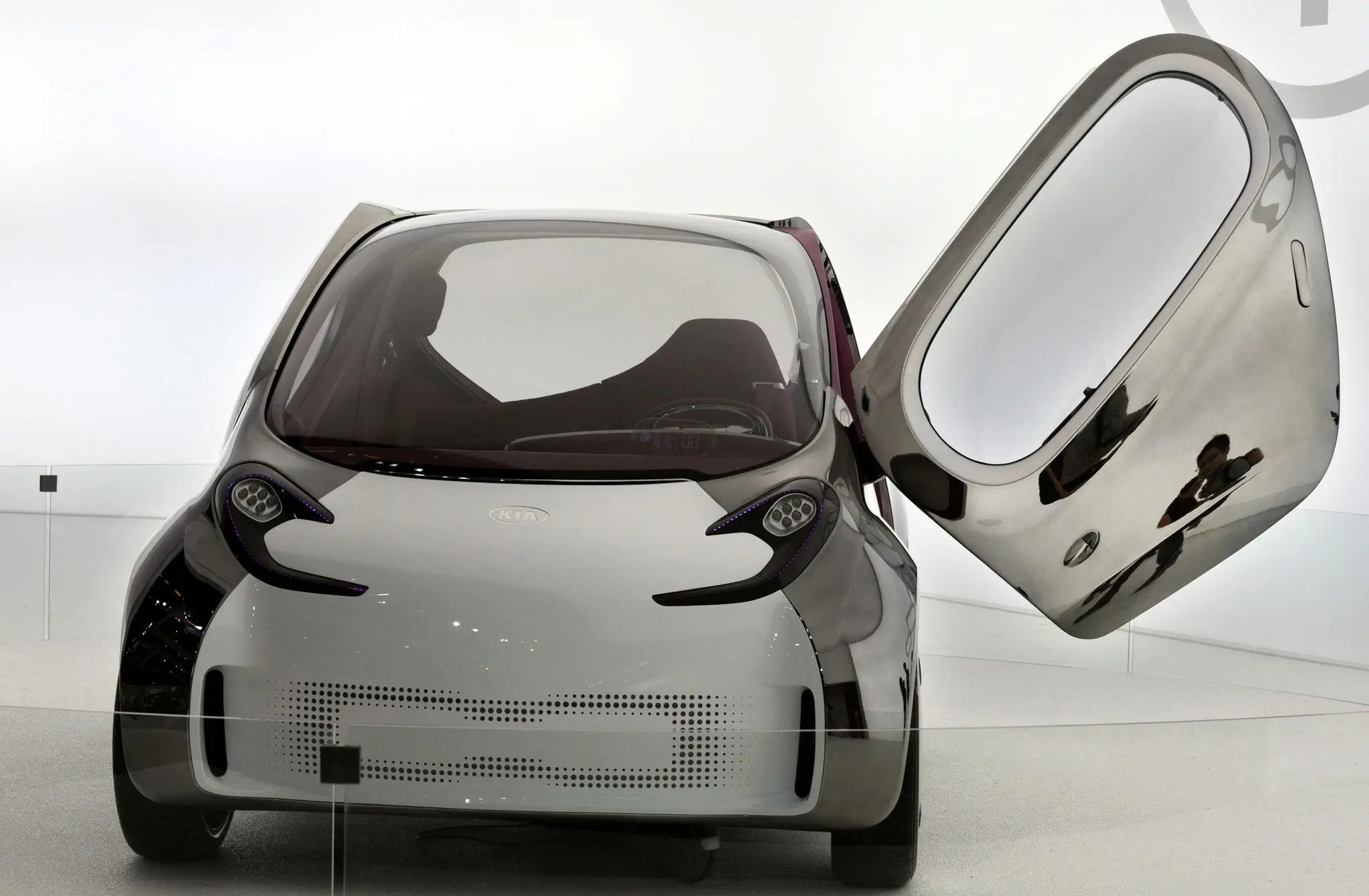
At only 3 meters (9.8 feet) long, the Pop was significantly smaller than most production vehicles of its era. Yet its designers managed to create seating for three occupants while maintaining a distinctive appearance that looked more like a concept from a science-fiction movie than a typical city car.
Its sleek profile, chrome-like finish, and flowing curves helped distinguish it from the boxy microcars commonly seen in urban settings.
A Design Unlike Anything Else in Kia’s Lineup
One of the most memorable aspects of the Pop was its dramatic exterior design.
Rather than following traditional automotive proportions, the concept embraced a teardrop-inspired shape intended to improve aerodynamic efficiency. The smooth bodywork flowed from front to rear with very few sharp edges, creating a futuristic silhouette that immediately stood out on the show floor.
Exterior Highlights
- Highly aerodynamic body shape
- Chrome-colored finish
- Large oblong side windows
- Front-hinged doors
- Distinctive LED lighting elements
- Minimalist wheel design
Kia designers reportedly described the vehicle as resembling a “wild atom,” reflecting its unconventional and energetic appearance.
The concept’s visual identity was not merely for show. Every curve and surface contributed to efficiency, helping maximize the vehicle’s electric driving range while minimizing energy consumption.
Interior Innovation in a Tiny Footprint
While the exterior attracted attention, the cabin revealed just how creative Kia’s designers were.
Instead of attempting to replicate a conventional small-car layout, the team completely rethought passenger accommodation. The vehicle featured a unique three-seat arrangement that optimized interior space despite its compact dimensions.
The front area included a bench-style passenger seat, while an angled rear seat provided accommodation for a third occupant.
This unconventional setup created a surprisingly spacious environment for such a small vehicle.
A Space-Inspired Cabin
The interior featured a striking purple color scheme inspired by spacecraft and futuristic environments. Kia intended the color palette to create a calming atmosphere amid busy urban surroundings.
Additional cabin innovations included:
- Transparent Organic LED (TOLED) display technology
- Minimal physical controls
- Simplified dashboard architecture
- Lightweight interior materials
- Advanced digital information display
Perhaps the most futuristic feature was the transparent display panel that functioned as a head-up information system. In 2010, this approach felt revolutionary and hinted at technologies that would later become more common in modern EVs.
Electric Powertrain and Performance
Beneath its futuristic bodywork, the Pop utilized an electric powertrain designed specifically for urban mobility.
The vehicle featured a rear-mounted electric motor producing approximately 50 kW (67 horsepower) and 190 Nm of torque.
While those numbers may seem modest today, they were more than adequate for a lightweight city-focused vehicle.
Key Specifications
| Specification | Kia Pop Concept |
|---|---|
| Vehicle Type | Electric Concept Car |
| Debut Year | 2010 |
| Length | 3.0 meters |
| Seating Capacity | 3 |
| Motor Output | 50 kW (67 hp) |
| Torque | 190 Nm |
| Battery Type | Lithium Polymer Gel |
| Driving Range | Up to 160 km (99 miles) |
| Top Speed | 140 km/h (87 mph) |
| Drive Layout | Rear-Motor Configuration |
The use of lithium polymer gel batteries was particularly notable at the time. Kia viewed this battery technology as an important step toward practical electric mobility, offering a balance between weight, efficiency, and packaging.
With an estimated range of approximately 160 kilometers (99 miles), the Pop delivered enough capability for typical urban commuting patterns.
How the Pop Compared to Other City-Car Concepts
Around the same period, several manufacturers were experimenting with compact electric mobility solutions. However, the Kia Pop took a distinctly different approach.
| Model | Length | Seating | Range |
|---|---|---|---|
| Kia Pop | 3.0 m | 3 | 160 km |
| Smart Fortwo Electric Drive | 2.7 m | 2 | Approximately 135 km |
| Renault Twizy | 2.3 m | 2 | Approximately 100 km |
| Nissan Leaf (2010) | 4.4 m | 5 | Approximately 160 km |
What made the Pop particularly interesting was its ability to deliver range comparable to larger early electric vehicles while maintaining an extremely compact footprint.
Instead of simply shrinking a conventional car, Kia focused on maximizing urban practicality through innovative packaging and lightweight design.
A Vision That Arrived Before Its Time
Looking back, many of the ideas introduced by the Pop seem remarkably forward-thinking.
Today, cities worldwide are investing in:
- Low-emission transportation
- Compact EVs
- Shared mobility solutions
- Sustainable urban planning
- Smart vehicle interfaces
In 2010, these trends were still emerging. The Pop anticipated many of the conversations now shaping modern automotive development.
Its emphasis on efficient use of space, reduced environmental impact, and digital interaction mirrors the direction many automakers have since pursued.
I remember seeing images of the Pop years after its debut and being surprised by how many of its futuristic design ideas resemble concepts that modern electric vehicles are only now beginning to explore.
Why the Kia Pop Still Matters
The true significance of the Pop extends beyond its specifications.
Many concept cars exist solely to attract attention at auto shows, but this vehicle served as a design laboratory. It allowed Kia engineers and designers to experiment with electric propulsion, innovative interiors, lightweight construction, and advanced digital displays.
Several principles showcased in the Pop later influenced Kia’s broader approach toward electrification and future mobility solutions.
More importantly, it demonstrated that practical transportation does not have to be boring. The concept proved that sustainability, efficiency, and emotional design could coexist within a single vehicle.
Imagine a young professional living in a crowded downtown area who commutes only a few miles each day, struggles to find parking, and wants a vehicle with minimal environmental impact. The Pop was designed precisely around that type of lifestyle, offering a glimpse of how future urban transportation could become smarter, smaller, and more efficient.
Related: Kia Niro Overview
Conclusion
The Kia Pop remains one of the most distinctive concept cars ever created by Kia. Introduced at the 2010 Paris Motor Show, it combined futuristic styling, innovative packaging, and electric propulsion into an ultra-compact vehicle designed specifically for city life.
Although it never entered production, its influence extends beyond the auto show stage. The concept anticipated many trends that now define modern mobility, including electrification, space-efficient design, digital interfaces, and environmentally conscious transportation.
More than a decade later, the Pop serves as a reminder that some of the automotive industry’s most important ideas begin as bold experiments. While drivers never had the opportunity to purchase one, the concept successfully showcased how Kia envisioned the future of urban mobility long before electric vehicles became mainstream.
FAQs
What is the Kia Pop?
The Kia Pop is a fully electric concept car unveiled at the 2010 Paris Motor Show. It was designed as a futuristic city vehicle focused on compact dimensions, efficiency, and zero-emission transportation.
Was the Kia Pop ever produced?
No. The Pop remained a concept vehicle and was never approved for mass production.
How many people could the Kia Pop seat?
The vehicle featured an innovative three-seat layout, including a front passenger bench and an angled rear seat.
What was the driving range of the Kia Pop?
The concept offered an estimated driving range of up to 160 kilometers (approximately 99 miles) on a full charge.
What type of battery did the Kia Pop use?
It utilized lithium polymer gel battery technology, which Kia considered a promising solution for future electric vehicles.
Why is the Kia Pop important?
The Pop showcased early ideas surrounding electric mobility, urban transportation, advanced displays, and efficient vehicle packaging. Many of these concepts became increasingly relevant as the automotive industry shifted toward electrification.