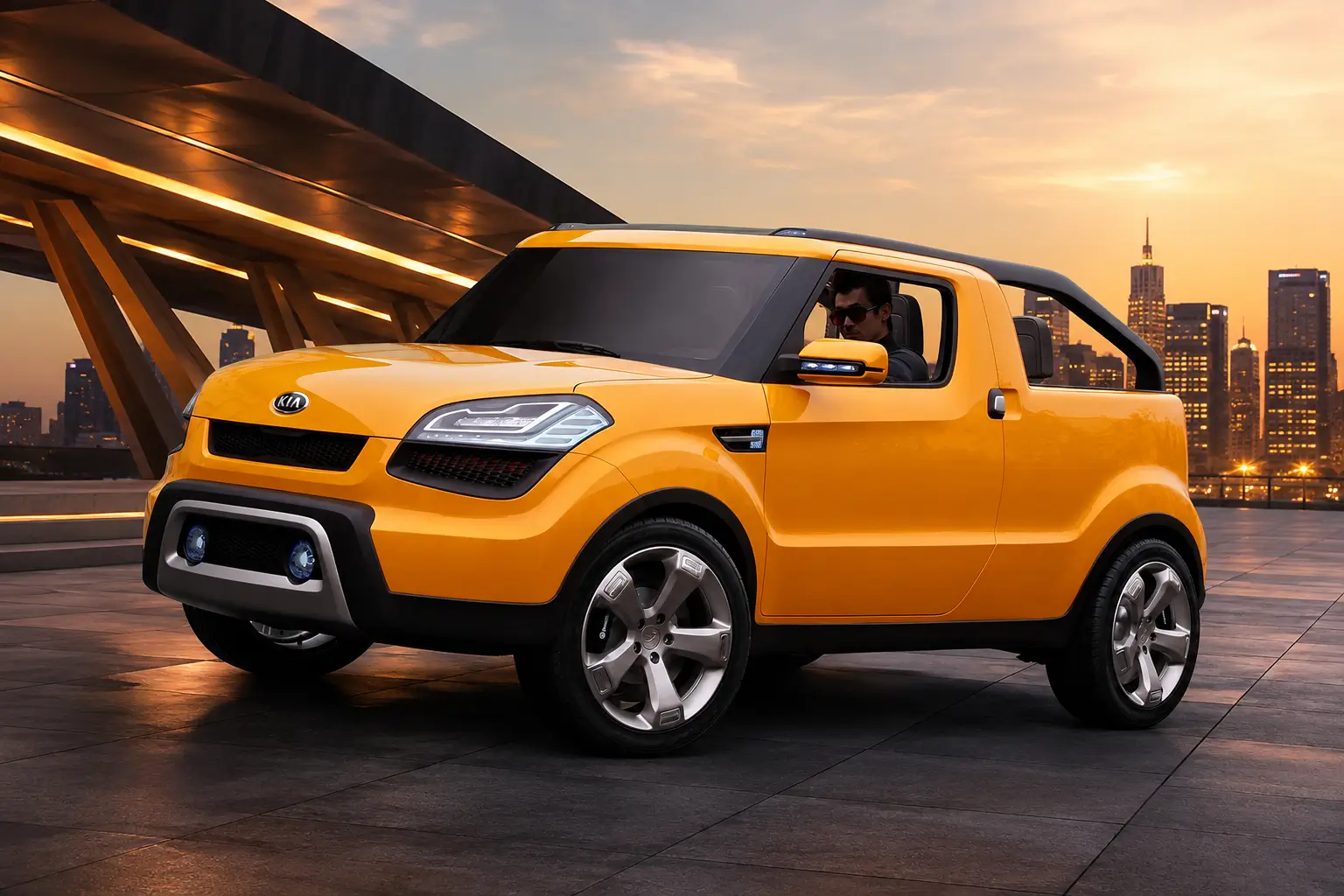
The Kia Soul’ster was never a normal concept car. It was part beach cruiser, part compact pickup, part convertible, and unmistakably related to the boxy Kia Soul. Unveiled at the 2009 North American International Auto Show in Detroit, the two-door show vehicle explored what might happen if Kia removed two doors, shortened the windshield, opened the roof, and turned an urban hatchback into a weekend lifestyle machine. Kia described it as an efficient front-wheel-drive vehicle based on the production Soul and aimed at active, budget-conscious buyers.
What Was the Kia Soul’ster?
At its core, the Soul’ster was a four-passenger, two-door interpretation of the first-generation Soul. The regular production model was a five-door, five-passenger vehicle; the concept exchanged some everyday convenience for openness and a more recreational personality.
A shortened windshield gave it a lower, more aggressive stance. Its two-piece removable top allowed the front and rear cabin sections to be opened independently. The integrated mid-body roll bar also carried the roof’s slider tracks while adding protection that a traditional open-top design might lack.
One detail is often blurred in quick summaries: the 1.6-liter and 2.0-liter engines were proposed choices for a possible production version. The Soul’ster never became a retail model with multiple trims.
Industrial Styling With a Beach-Ready Attitude
The concept wore a bright “Soul’r Yellow” finish and visible screw-like borders inspired by aircraft rivets. That industrial theme continued through the anodized skid-pad insert, fender vents, roll-bar header, and wheel details.
Kia added 19-inch five-spoke aluminum-alloy wheels, amber illumination beneath the headlamps, blue-toned lighting elements, and dual chrome exhaust outlets with polished aluminum tips and carbon-fiber inner sleeves.
The result preserved the Soul’s upright proportions while suggesting surfboards, warm-weather roads, and outdoor gear. Its front-wheel-drive layout, however, made it an urban runabout rather than a serious off-roader.
A Simple but Clever Four-Seat Cabin
Inside, Kia deliberately kept some features basic. Manual crank windows became a design statement, while audio speakers were integrated into the dashboard. Four individual seating positions replaced the regular Soul’s five-passenger layout. Cantilevered seats appeared to float above the floor and helped create additional rear legroom.
The front passenger seat and rear seats could fold flat to accommodate longer recreational equipment. Storage compartments sat beneath the rear seats, in the rear cargo area, and below the cargo floor. It did not have a conventional separate pickup bed; instead, it turned the passenger compartment into adaptable carrying space.
In my experience analyzing concept-vehicle packaging, this is what makes the Soul’ster unusually convincing: its memorable design choices were connected to usable space rather than decorative technology alone.
Proposed Performance and Fuel Economy
Kia outlined two U.S.-focused powertrain possibilities. The entry configuration paired a 1.6-liter four-cylinder producing about 120 horsepower with a five-speed manual transmission. A 2.0-liter four-cylinder was projected at roughly 140 horsepower and could use either the five-speed manual or a four-speed automatic.
Both configurations were front-wheel drive, and Kia estimated fuel economy of 30 mpg or better. Other markets could theoretically have received a 124-horsepower 1.6-liter gasoline engine or a 1.6-liter turbo-diesel.
The modest numbers supported Kia’s affordability-first positioning rather than suggesting a performance model.
Where It Fit Among Boxy Utility Vehicles
| Vehicle | Status | Body and roof | Utility approach | Main advantage |
|---|---|---|---|---|
| Kia Soul’ster | Concept only | Two doors; removable two-piece roof | Four seats, fold-flat seating, hidden storage | Open-air personality with compact-car efficiency |
| 2010 Kia Soul | Production | Five doors; fixed roof | Five-passenger urban utility | Better access and everyday practicality |
| 2009 Honda Element | Production | Fixed-roof utility body | Four seats, removable or reconfigurable rear seating | Cargo flexibility and available all-wheel drive |
| 2010 Scion xB | Production | Five-door box-shaped hatchback | Fold-flat rear seat and flat cargo floor | Roomy, customizable daily transportation |
The Honda Element was the more serious cargo tool, offering up to 74.6 cubic feet with its rear seats removed, a washable utility-focused interior, and available Real Time 4WD. The Scion xB provided conventional five-door usability, a 60/40-folding rear seat, and a flat cargo floor.
The concept’s advantage was emotional: convertible-like openness without the low seating position or limited flexibility of a traditional roadster.
How It Could Have Worked in Real Life
Picture a driver near San Diego who commutes during the week and spends Saturdays surfing or cycling. With both roof panels fitted, the Soul’ster could serve as a small commuter. On the weekend, the driver could remove one or both sections, fold the passenger-side seats, load longer gear, and still bring friends.
Likely compromises included more wind noise, less weather security, awkward rear access, and limited towing or trail ability. It was a lifestyle hatchback, not a pickup or dedicated 4×4.
This balance was the vehicle’s most valuable proposition. Rather than asking buyers to own a practical commuter and a separate recreational vehicle, the Soul’ster attempted to cover both roles in one affordable, city-friendly package.
Why It Never Reached Dealerships
Kia never announced a production Soul’ster, and no retail model followed the show car. It did receive the 2009 Concept Truck of the Year award, confirming that the unusual design attracted more than casual attention.
Kia gave no definitive public explanation. Structural, sealing, safety-development, and manufacturing costs are plausible considerations, but they are not confirmed reasons.
A two-door vehicle also appeals to a narrower audience than a five-door hatchback. Producing it would have required Kia to balance the Soul’ster’s low-price promise against the added expense of reinforcing an open-roof body and developing removable panels that could meet durability, weather, and safety expectations.
The concept has become more significant with time. Kia confirmed that the regular Soul would retire in the United States after the 2025 model year, following more than 1.5 million U.S. sales since 2009. The Soul’ster now stands as one of the boldest unrealized branches of that nameplate’s history.
Related: Kia Slice Overview
Conclusion
The Kia Soul’ster combined the compact size and affordability of the Soul with the openness of a convertible and the adaptable attitude of a small utility vehicle. Its removable roof, four-seat cabin, fold-flat layout, hidden storage, and realistic powertrain proposals made it more credible than a typical fantasy concept.
It was not fast, luxurious, or genuinely rugged. It was useful, cheerful, efficient, and difficult to categorize—and that was precisely its value. Had Kia produced it at an attainable price, it might have created a niche that still feels underserved.
The Soul’ster ultimately matters not because it predicted a specific production model, but because it showed how far Kia was willing to stretch the Soul platform. It transformed an economical urban hatchback into something expressive, recreational, and unexpectedly versatile without erasing the personality of the original vehicle.
FAQs
Was the Kia Soul’ster ever produced?
No. It remained a 2009 concept vehicle and was never sold as a retail Kia model.
Was it a convertible or a pickup?
It blended ideas from both, but it was closer to an open-air compact utility vehicle. It used removable roof panels and flexible interior cargo space rather than a separate pickup bed.
How many people could it seat?
The concept was designed for four occupants, with two front seats and two rear seating positions.
What engines were planned?
Kia proposed a 120-horsepower 1.6-liter four-cylinder and a 140-horsepower 2.0-liter four-cylinder for a possible production version. These were proposals rather than confirmed retail powertrains.
Was the Soul’ster all-wheel drive?
No. Kia described it as a front-wheel-drive vehicle.
Did it have a real pickup bed?
Not in the conventional sense. Its fold-flat seats and adaptable rear cargo area created pickup-like utility inside the open passenger compartment.
What fuel economy was expected?
Kia estimated that the proposed 1.6-liter and 2.0-liter configurations could achieve at least 30 mpg. Because the vehicle was never produced, there was no official EPA rating for a retail Soul’ster.
Could Kia revive the idea as an electric vehicle?
Kia has not announced a Soul’ster revival. An electric reinterpretation would be technically conceivable, but any future model remains speculation unless the automaker officially confirms it.