The Kia Slice never reached showrooms, yet it previewed what American buyers would soon demand from crossovers: SUV-like room, sedan-based road manners, flexible seating, and a shape without the bulk of a traditional sport-utility vehicle.
Officially named the Kia KCD-1 Slice, it debuted on January 7, 2003, at the North American International Auto Show in Detroit. Kia positioned it as an alternative to heavy, dynamically awkward SUVs. The concept’s real achievement was packaging six adults, long cargo, easy cabin access, and sporty chassis hardware within a body only 177 inches long.
What Was the Kia KCD-1 Slice?
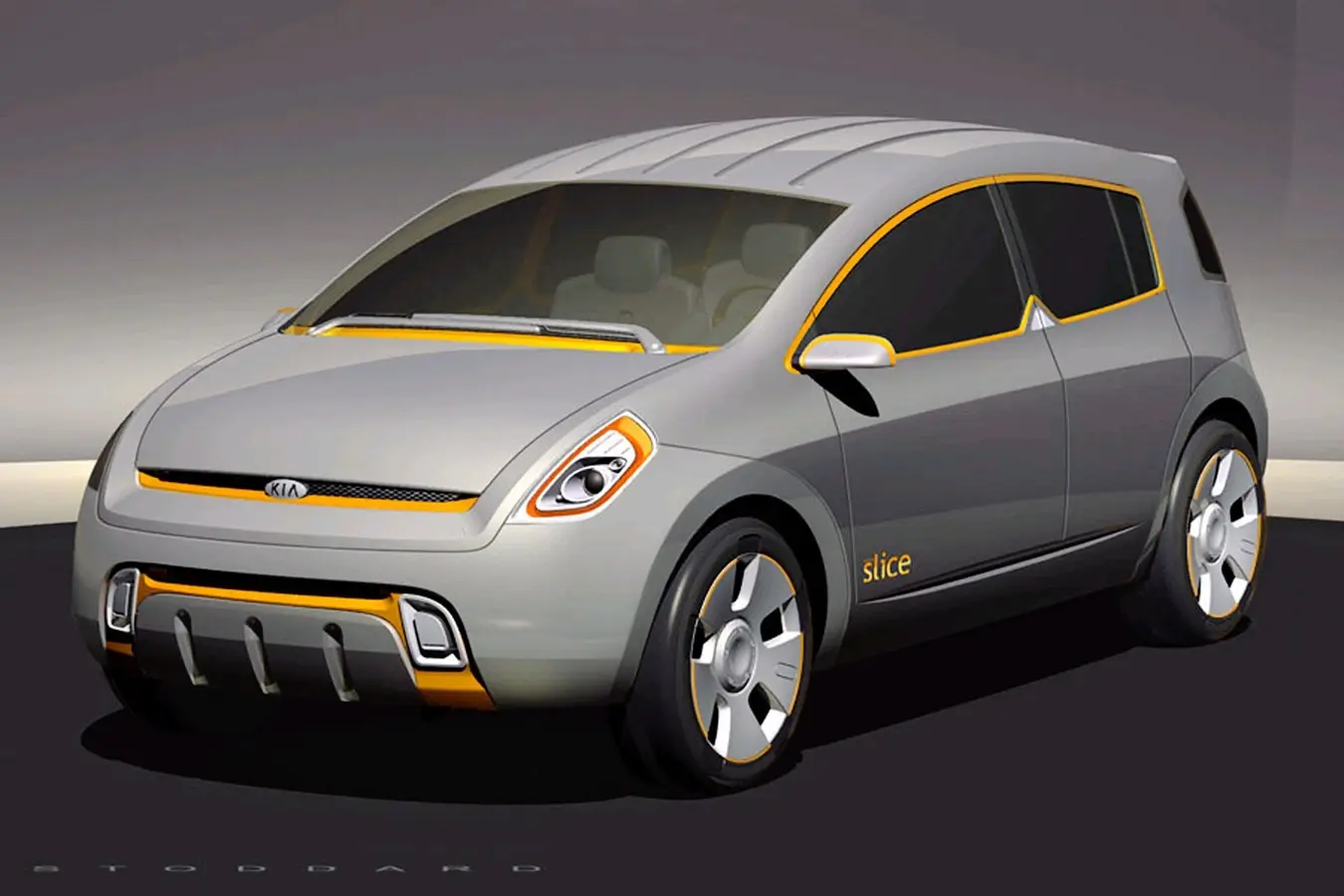
The KCD-1 was a car-based crossover built on a modified Kia Optima platform. Its 112-inch wheelbase was almost six inches longer than the Optima chassis beneath it, although the Slice’s body was more than eight inches shorter overall. It measured 72 inches wide and 63 inches tall, giving it useful interior volume without truck-like proportions.
The exterior combined silver-gray bodywork with vivid orange accents, a steep windshield, an arcing roofline, high-mounted taillights, and 19-inch dish-style wheels. Kia said the “Slice” name reflected a design process focused on stripping away unnecessary details and making individual elements appear cut from the surrounding surfaces.
Quick summaries usually stop after noting that it seated six, used a V-6, and was proposed with front- or all-wheel drive. The richer story is that Kia was testing a complete lifestyle-vehicle formula before flexible crossovers became standard family transportation.
A Cabin Built Around Flexibility
The Slice used three rows of seating for up to six adults. Kia said the third row was intended for adults, not merely occasional use. Its slim, furniture-inspired seats could recline or fold flat, and their rear surfaces lined up to form a continuous platform for skis, lumber, or other long items.
Wide, pillarless side openings were among the concept’s most memorable features. Conventional front doors worked with rear-hinged back doors, eliminating the fixed center pillar and creating a broad entryway. Small push-button releases operated the solenoid-controlled doors.
Inside, a high seating position and low dashboard were intended to improve visibility. A hooded instrument pod placed key information ahead of the driver, while a central control unit used large buttons and a pop-up LCD screen. Storage appeared in the doors, console, and areas above the rear wheels.
From my experience comparing concept-car archives, the most important ideas are often not the dramatic styling details but the packaging decisions that later become normal.
Engine and Chassis Details
Power came from an aluminum-block 2.7-liter DOHC V-6 with 24 valves, multi-port fuel injection, and a dual-mode intake system. Kia’s original U.S. release did not provide a verified horsepower figure, so exact output numbers repeated by some secondary sources should be treated cautiously.
The V-6 was paired with Kia’s Sportmatic transmission, which offered automatic operation or manual gear selection. Kia envisioned both front-wheel-drive and all-wheel-drive versions.
The front suspension used double wishbones, coil springs, and tubular dampers; the rear used a multi-link design. Stabilizer bars were fitted at both ends, while engine-speed-sensitive rack-and-pinion steering supported the sporty brief. The concept rode on 235/45R19 tires.
Because the Slice never entered production, no independently verified acceleration, fuel-economy, towing, crash-test, or real-world handling figures exist.
Where It Fit Among Early Crossovers
The Slice arrived while automakers were still deciding what a crossover should be. The following vehicles were not exact rivals, but each addressed a similar mix of car-like driving and flexible utility.
| Vehicle | Status | Seating | Main purpose | Slice’s distinction |
|---|---|---|---|---|
| Kia KCD-1 Slice | 2003 concept | 6 | Sporty, flexible three-row utility | Six seats, pillarless access, V-6 power, and sport-tuned suspension |
| Honda Element | 2003 production | 4 | Adventure-friendly cargo versatility | Slice added two seats and sleeker styling |
| Toyota Matrix | 2003 production | 5 | Compact hatchback utility with available AWD | Slice was a larger three-row concept with V-6 power |
| Chrysler Pacifica | 2004 production | 6 | Premium car-based family crossover | Pacifica reached production; Slice was shorter and more experimental |
The Honda Element came closest to the Slice’s access-and-cargo creativity, with a center-pillarless opening, wide-opening side doors, and a highly configurable cabin. The Toyota Matrix represented the compact, economy-oriented side of the trend, offering five-passenger practicality and available all-wheel drive. Chrysler’s Pacifica showed that buyers could accept a six-seat vehicle blending wagon, minivan, and SUV traits.
The Slice’s distinctive value was its attempt to unite those approaches: Element-like access, Matrix-like car-based thinking, and Pacifica-style six-passenger usefulness, all wrapped around a more performance-focused chassis.
How the Idea Worked in Everyday Life
Picture a couple taking two children and two grandparents on a weekend trip. All six could ride together, with the rear seats reclined for comfort. A few days later, the seats could fold into a long platform for home-improvement supplies. During the week, the same vehicle would be compact enough for commuting and intended to feel livelier than a body-on-frame SUV.
That scenario explains the concept better than its orange dashboard. Kia was proposing one vehicle for family travel, errands, hobbies, and enjoyable driving—the same broad mission that defines many modern crossovers.
There would have been trade-offs. Rear-hinged doors without a center pillar create engineering challenges involving body rigidity, side-impact protection, weather sealing, and production cost. Six adult seats in a 177-inch vehicle could also leave limited luggage room when every seat was occupied. These are reasonable engineering considerations rather than documented faults, since the vehicle never underwent a public production-model evaluation.
Did Kia Produce the Slice?
No. Kia stated that no production plans had been announced. The company intended to display the vehicle at additional North American and international auto shows to measure public reaction, but the KCD-1 name never became a retail model.
The Slice is sometimes linked informally to later Kia vehicles such as the Soul or Rondo. Similar themes exist, including unconventional styling and adaptable passenger space, but the available original material does not establish a direct production lineage.
It is more accurate to call the Slice an early expression of ideas that later became central to the crossover market: a car-derived platform, elevated seating, flexible cargo arrangements, distinctive styling, and available all-weather capability.
Related: Kia Rondo Taxi Overview
Conclusion
The Kia Slice matters because it captured the crossover’s emerging purpose before the formula became predictable. It combined six-passenger seating, fold-flat cargo flexibility, pillarless access, a V-6, available all-wheel drive, and a suspension intended to deliver responsive handling.
It was never sold, priced, EPA-rated, or crash-tested as a production vehicle. Even so, the KCD-1 deserves more than a footnote. Its strongest idea was the belief that a reasonably compact vehicle could be practical, versatile, and enjoyable to drive without behaving or looking like a traditional SUV.
FAQs
Was the Kia Slice a production car?
No. It was a 2003 concept vehicle, and Kia announced no production program.
What engine did the Kia Slice have?
It used a 2.7-liter aluminum-block DOHC V-6 with multi-port fuel injection and a Sportmatic transmission offering automatic or manual gear selection.
How many people could it carry?
Kia designed the concept to accommodate six adults across three flexible rows.
Did it have all-wheel drive?
Kia proposed both front-wheel-drive and all-wheel-drive configurations, although neither version entered mass production.
Can you buy a Kia KCD-1 Slice today?
Not through a normal new- or used-car market. It was an auto-show concept rather than a mass-produced vehicle.
Did it become the Kia Soul or Rondo?
No direct connection has been confirmed. The vehicles share some practical design themes, but calling either one the production version of the Slice would go beyond the available evidence.