When Kia pulled the covers off the Kia GT4 Stinger at the North American International Auto Show, it didn’t just introduce a concept car, it quietly challenged long-standing perceptions of what Kia could be. Up until that moment, Kia was widely recognized for value-packed sedans and crossovers. The GT4 Stinger, however, rewrote that narrative with a bold, unapologetically driver-focused identity.
This wasn’t a watered-down attempt at performance. It was a statement: lightweight, rear-wheel-drive, manual transmission, and stripped of unnecessary complexity. In an era where technology often overshadows driving purity, the GT4 Stinger leaned hard in the opposite direction.
A Design That Signals Intent
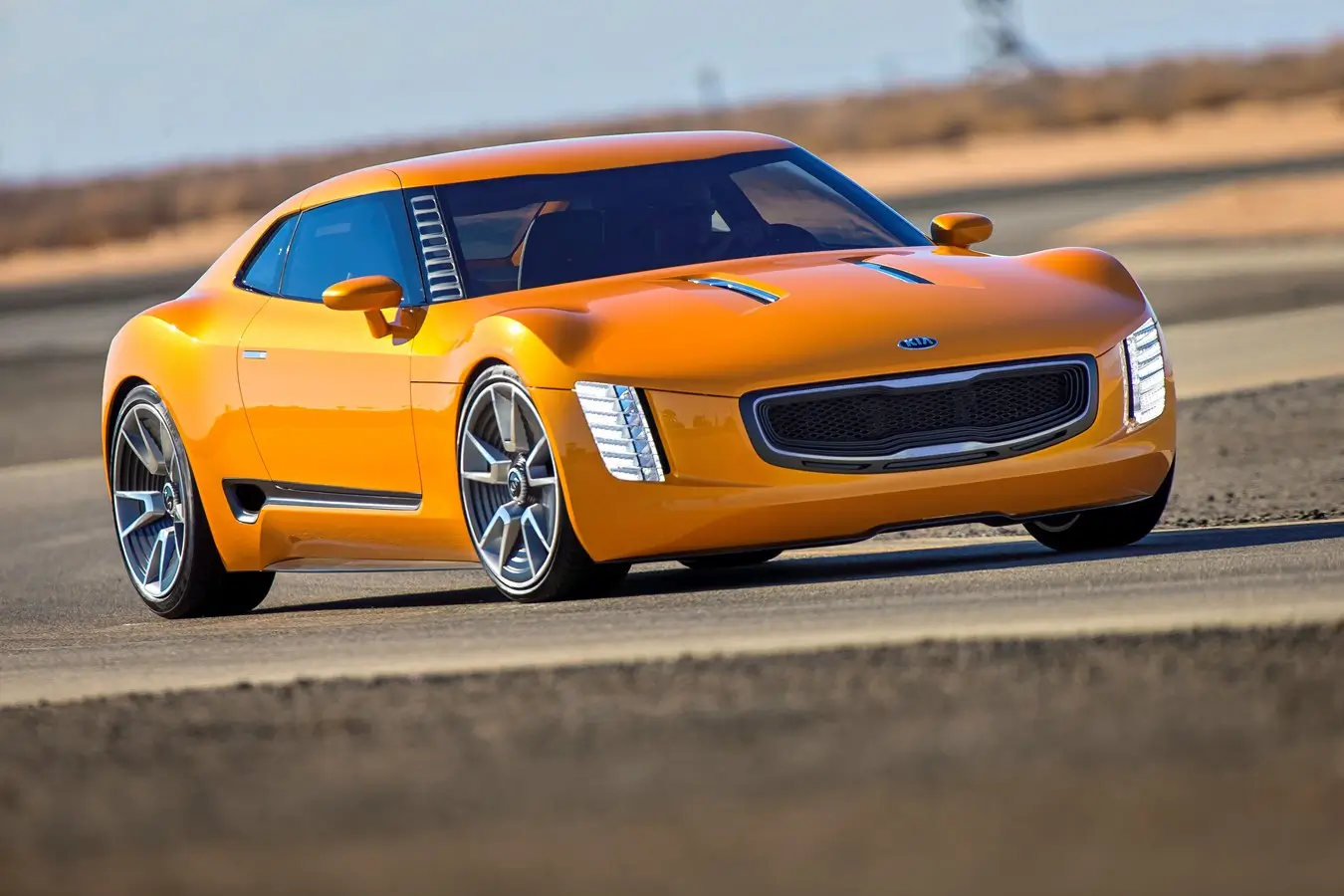
At first glance, the GT4 Stinger feels more like a European track weapon than a typical Korean concept. Its proportions tell the story long hood, short rear deck, and a low, aggressive stance that hints at near-perfect balance.
The signature “Ignition Yellow” paint ensures it never blends into the background, but it’s the details that elevate it further. Air vents sculpted into the hood, muscular fenders, and a hatchback-style rear give the illusion of a mid-engine layout. While it borrows subtle cues from models like the Kia Optima and Kia Cadenza, the GT4 Stinger clearly operates in a different league.
Inside, the minimalism becomes even more pronounced. There’s no infotainment system, no clutter, and almost no compromise. The cockpit feels purpose-built deep bucket seats, exposed metal accents, and controls that exist solely for driving. It’s the kind of interior that prioritizes connection over comfort.
Performance Built Around the Driver
Under the hood sits a 2.0-liter turbocharged inline-four engine producing around 315 horsepower. That might not sound outrageous by today’s standards, but paired with a lightweight chassis (just under 2,900 pounds), it creates an exceptional power-to-weight ratio.
More importantly, the GT4 Stinger sends power to the rear wheels through a six-speed manual transmission. That decision alone sets it apart in a segment increasingly dominated by automatics and dual-clutch systems.
There’s also a deliberate absence of excessive driver aids. Kia’s engineers emphasized mechanical grip, chassis balance, and raw feedback instead of electronic intervention. For purists, that’s not just appealing rare.
To put it into perspective, here’s how the GT4 Stinger concept stacks up against other enthusiast favorites:
| Model | Power | Drivetrain | Transmission | Approx. Weight | Character |
|---|---|---|---|---|---|
| Kia GT4 Stinger | 315 hp | RWD | 6-speed manual | ~2,874 lbs | Raw, lightweight, track-focused |
| Hyundai Genesis Coupe | 274–348 hp | RWD | Manual/Auto | ~3,400 lbs | Balanced daily sports coupe |
| Subaru BRZ | ~228 hp | RWD | Manual/Auto | ~2,800 lbs | Lightweight precision handling |
| Ford Mustang EcoBoost | ~310 hp | RWD | Manual/Auto | ~3,500 lbs | Muscle meets modern tech |
Where competitors often balance comfort and performance, the GT4 Stinger leans decisively toward driving purity. It is less about daily convenience and more about the thrill of the road.
Why It Still Matters Today
Although the GT4 Stinger never reached production in its original form, its influence is undeniable. It paved the way for vehicles like the Kia Stinger, which brought rear-wheel-drive performance into Kia showrooms for the first time.
More importantly, it proved that Kia could design a car that enthusiasts genuinely desired—not just for its price, but for its personality.
At a time when many automakers were adding layers of technology to enhance safety and convenience, Kia took a bold risk by removing them. That decision created a unique identity: a back-to-basics sports coupe that prioritized driver engagement above all else.
A Different Kind of Value
What made the GT4 Stinger particularly compelling wasn’t just its performance—it was the promise of accessibility. Early discussions suggested a potential price point under $25,000 if it reached production, positioning it as an “affordable exotic.”
That’s where it truly stood apart. While brands like Porsche and BMW dominate the performance conversation, they often come with premium pricing. The GT4 Stinger hinted at delivering a similar emotional experience at a fraction of the cost.
This approach aligns perfectly with Kia’s broader philosophy: delivering more than expected. But in this case, “more” didn’t mean extra features more connection, more control, and more excitement behind the wheel.
Practical Driving Experience and Everyday Usability
Imagine carving through a winding backroad in Virginia’s countryside early on a Sunday morning. The road is empty, the air is crisp, and every input steering, throttle, braking translates instantly into motion. There’s no artificial filtering, no digital interference. Just you, the machine, and the road.
That’s exactly the kind of experience the GT4 Stinger was built to deliver.
I once had the chance to sit in a concept vehicle with a similarly stripped-down philosophy, and the absence of distractions made the driving experience feel surprisingly intense almost like rediscovering what driving is supposed to be.
What Could Have Been and What Still Might Be
The biggest question surrounding the GT4 Stinger has always been: why didn’t it make production?
Market realities likely played a role. Affordable sports coupes are a niche segment, and profitability can be challenging. Still, the concept’s overwhelmingly positive reception suggests there’s demand especially among enthusiasts who crave simplicity in an increasingly complex automotive world.
Even today, the GT4 Stinger feels relevant. In fact, it might be even more appealing now, as manual transmissions and lightweight designs become rarer.
Related: Kia K5 GT Overview
Conclusion
The Kia GT4 Stinger wasn’t just a concept car, it was a glimpse into an alternate future where Kia fully embraced its performance potential. With its lightweight construction, rear-wheel-drive layout, and uncompromising focus on the driver, it challenged expectations and redefined what the brand could achieve.
While it never reached production, its spirit lives on in Kia’s performance-oriented models and in the minds of enthusiasts who still wonder what might have been.
In a market crowded with high-tech, feature-heavy vehicles, the GT4 Stinger stands out as a reminder that sometimes, less truly is more.
FAQs
What is the Kia GT4 Stinger?
The Kia GT4 Stinger is a concept sports coupe unveiled in 2014, designed as a lightweight, rear-wheel-drive performance car focused on driving purity.
Did the Kia GT4 Stinger go into production?
No, the GT4 Stinger remained a concept, although it influenced later models like the Kia Stinger sports sedan.
What engine does the GT4 Stinger have?
It features a 2.0-liter turbocharged inline-four engine producing approximately 315 horsepower.
Why is the GT4 Stinger significant?
It marked Kia’s first serious attempt at a dedicated rear-wheel-drive sports car and showcased the brand’s potential in the performance segment.
Could Kia still build a car like the GT4 Stinger?
While there’s no official confirmation, growing interest in enthusiast-focused vehicles means the idea isn’t entirely off the table.