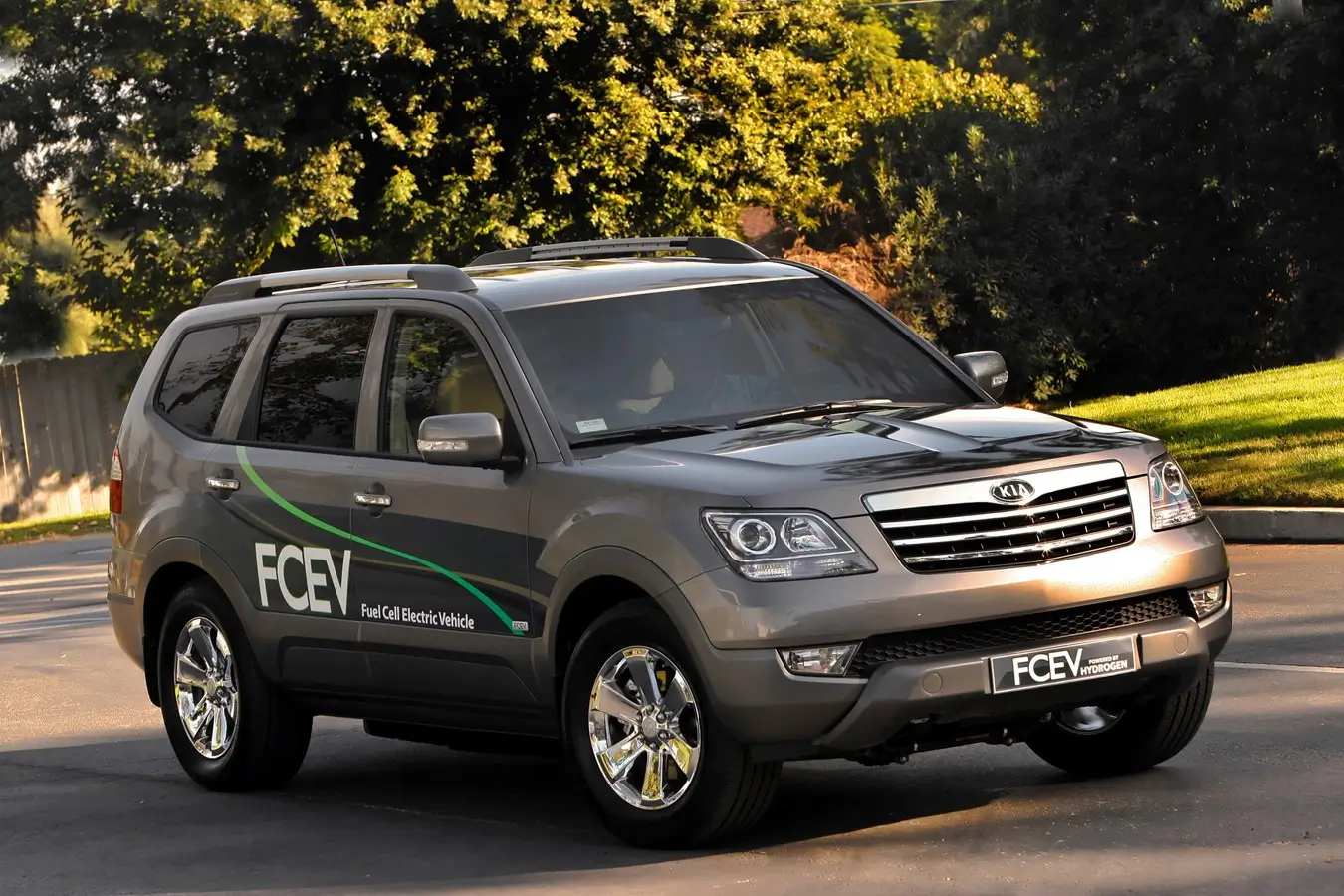
Before hydrogen vehicles became part of mainstream automotive conversations, Kia Corporation was already experimenting with bold ideas. One of the most fascinating yet often overlooked chapters in its innovation story is the Kia Borrego FCEV. Unveiled around 2008–2009, this full-size SUV wasn’t built for dealership floors. Instead, it served as a rolling laboratory, pushing the boundaries of fuel cell technology long before the world was ready.
Today, as hydrogen mobility re-enters the spotlight with vehicles like the Hyundai Nexo and Toyota Mirai, revisiting this early prototype reveals just how forward-thinking Kia’s engineering efforts were.
A Glimpse Into Early Hydrogen Innovation
The Borrego FCEV was based on the production Kia Borrego (known globally as the Mohave), a rugged SUV platform typically associated with gasoline power. Transforming such a vehicle into a hydrogen-powered machine wasn’t just ambitious—it was technically demanding.
At its core, the vehicle featured a fuel cell stack that generated electricity by combining hydrogen with oxygen, emitting only water vapor. This clean energy system powered an electric motor, eliminating the need for traditional combustion.
What made this prototype stand out at the time was how seamlessly Kia integrated advanced technology into a familiar SUV form factor. Unlike smaller experimental vehicles, this one retained real-world practicality—seating, cargo space, and road presence.
Performance and Technical Highlights
For a concept from the late 2000s, the Borrego FCEV delivered surprisingly capable performance figures:
- Electric Motor Output: Around 154 horsepower
- Fuel Cell Stack Power: Approximately 134 kW
- 0–60 mph Acceleration: About 12.8 seconds
- Top Speed: Roughly 100 mph (160 km/h)
- Driving Range: Estimated near 426 miles (685 km) under ideal conditions
The inclusion of supercapacitors was particularly notable. These components stored energy captured during regenerative braking and released it quickly during acceleration, improving efficiency and responsiveness—an idea that’s now common in modern electrified vehicles.
Hydrogen was stored in high-pressure tanks (around 70 MPa / 10,000 psi), allowing for extended range without compromising too much interior space. This was a major engineering challenge, especially in a full-size SUV layout.
Why It Mattered More Than It Sold
The Borrego FCEV never entered production and that was never really the point.
Instead, it served as a technology demonstrator, bridging the gap between early experiments like the Kia Sportage FCEV and the more refined hydrogen systems seen today. It allowed engineers to test durability, packaging, thermal management, and real-world usability.
In simple terms, it answered a critical question: Can hydrogen power work in a large, practical SUV without sacrificing usability?
The answer was yes but with caveats.
Hydrogen Infrastructure Limitations and Market Readiness
Imagine this scenario: You’re driving a hydrogen-powered Borrego through a wide-open highway in California. The ride is silent, smooth, and emissions-free. You pass gas stations—but none of them can refuel your vehicle. Instead, you must plan your trip around a limited number of hydrogen stations.
That was the biggest obstacle then and to some extent, it still is today.
While the Borrego FCEV proved the technology was viable, the lack of hydrogen infrastructure made mass adoption unrealistic. This wasn’t a flaw of the vehicle itself, but rather a limitation of the ecosystem around it.
How It Stacks Up Against Modern Hydrogen Vehicles
Although it’s a concept from over a decade ago, comparing it to today’s hydrogen vehicles offers valuable perspective:
| Feature | Kia Borrego FCEV | Hyundai Nexo | Toyota Mirai |
|---|---|---|---|
| Vehicle Type | Full-size SUV | Compact SUV | Sedan |
| Power Output | ~154 hp | 161 hp | 182 hp |
| Range | ~426 miles | ~380 miles | ~402 miles |
| Top Speed | ~100 mph | 111 mph | 108 mph |
| Production Status | Prototype | Mass-produced | Mass-produced |
Interestingly, the Borrego’s estimated range was highly competitive even by today’s standards. That alone highlights how advanced the concept was for its time.
Driving Experience: What It Likely Felt Like
While most drivers never had the chance to experience this prototype, hydrogen fuel cell vehicles generally share a few defining traits: instant torque, near-silent operation, and smooth acceleration.
I once had a brief experience with a hydrogen prototype vehicle at an auto showcase, and the quiet, almost surreal driving feel made it clear that this technology offers a completely different kind of refinement compared to traditional engines.
The Borrego FCEV would likely have delivered a similar sensation combining the commanding presence of a full-size SUV with the serenity of electric propulsion.
Design and Practicality
One of the most impressive aspects of this concept was how little it compromised practicality. Engineers managed to package the fuel cell stack under the floor, preserving cabin space.
From the outside, it looked almost identical to the standard Borrego. Inside, it maintained the comfort and utility expected from a family SUV. This subtlety was intentional, it demonstrated that alternative powertrains didn’t require radical design changes to be viable.
What Makes This Concept Still Relevant Today
Many concept vehicles fade into obscurity, but the Borrego FCEV stands out for one reason: it predicted the future accurately.
Its combination of long range, fast refueling, and zero emissions mirrors what automakers are still striving to perfect. While battery electric vehicles dominate today’s market, hydrogen remains a promising solution for larger vehicles and long-distance travel.
The real distinction here is that Kia explored this space early quietly building expertise that would influence its broader electrification strategy.
Conclusion
The Kia Borrego FCEV wasn’t a commercial success because it was never meant to be. Instead, it was a bold experiment that proved hydrogen technology could work in a full-size SUV without sacrificing performance or practicality.
In hindsight, it feels less like a prototype and more like a preview of what the automotive industry is still working toward. As hydrogen infrastructure continues to grow and technology evolves, the ideas first tested in this vehicle may finally find their place on modern roads.
FAQs
What does FCEV mean?
FCEV stands for Fuel Cell Electric Vehicle, which uses hydrogen to generate electricity instead of relying on a battery alone.
Was the Kia Borrego FCEV ever sold to the public?
No, it remained a prototype and was used primarily for research and development purposes.
How far could it travel on a full tank?
The estimated range was around 426 miles under ideal conditions, which was impressive for its time.
Is hydrogen better than electric vehicles?
Each has advantages. Hydrogen offers faster refueling and longer range, while battery EVs benefit from more developed infrastructure.
Does Kia currently produce hydrogen vehicles?
As of now, Kia focuses more on battery electric vehicles, while its affiliate brand Hyundai Motor Company leads hydrogen development with models like the Nexo.