
Summary
The U.S. Air Force Test Center (AFTC) plans to acquire two Tesla Cybertrucks for use as instrumented target vehicles in precision-guided munition testing at White Sands Missile Range, New Mexico. The goal is to study how modern EV platforms especially stainless-steel exoskeleton designs and emerging 48-volt vehicle architectures react to real weapons effects and targeting sensors in realistic scenarios, including work that can support Special Operations Command (SOCOM) training needs.
Why the Air Force wants Cybertrucks ?
Recent contracting documents and reporting indicate the Air Force is compiling a diverse fleet of 33 target vehicles for a standoff precision-guided munitions (SOPGM) test series at White Sands. Among them: two Tesla Cybertrucks called out by name. The rationale is straightforward: if future adversaries field stainless-steel-clad electric trucks or similar EVs, the Pentagon wants validated data on how sensors, fuzes, and warheads interact with their materials, electrical systems, thermal signatures, and crash/fragmentation behaviors.
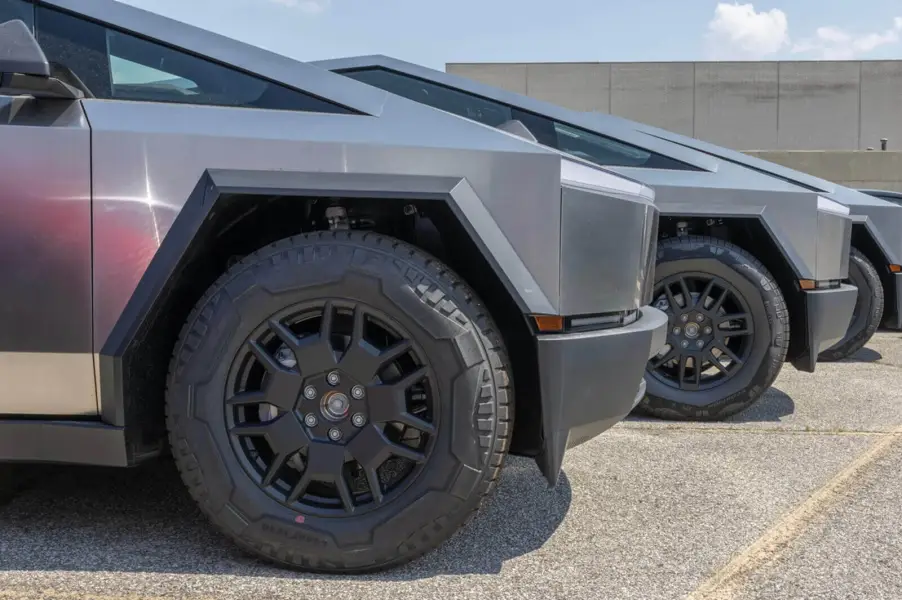
Unlike conventional pickups, the Cybertruck’s unpainted stainless-steel exoskeleton and nontraditional body geometry may scatter radar, IR, or lidar in atypical ways, and its high-voltage pack with a 48-volt low-voltage architecture presents different risk profiles for fire propagation, debris fields, and post-blast hazards. That makes it a useful “edge case” target for validating seeker performance, damage models, and safety procedures.
White Sands is a natural venue for this work. The range has long hosted live-fire testing for precision guided weapons, with test centers and range infrastructure tailored to collect high-fidelity telemetry and visual/thermal data in instrumented events.
What we know so far (and what’s still unclear)
- Quantity and venue: Two Cybertrucks requested as part of a 33-vehicle target set for tests at White Sands Missile Range.
- Lead organization: The Air Force Test Center (AFTC) coordinating test requirements.
- Purpose: Targets for precision-guided munition testing and realistic training use cases; some reporting links the requirement to SOCOM training needs.
- Vehicle specifics that matter: Stainless-steel exoskeleton construction and 48-volt architecture are among the differentiators called out in reporting and market-research notes.
- Status: The effort surfaced via contracting documentation and has been reported by multiple defense/tech outlets; as with any pre-award procurement, details (quantities, schedules, suppliers) may evolve before test execution.
How a Cybertruck target differs from a conventional pickup
| Attribute | Typical Painted Steel/Aluminum Pickup | Tesla Cybertruck (relevant to tests) |
|---|---|---|
| Body construction | Body-on-frame; painted steel/aluminum panels | Stainless-steel exoskeleton with angular geometry |
| Exterior coatings | Painted; predictable thermal/radar response | Unpainted stainless may alter radar/IR scatter and heat emissivity |
| Low-voltage system | 12V electrical | 48V low-voltage architecture impacts power distribution/failure modes |
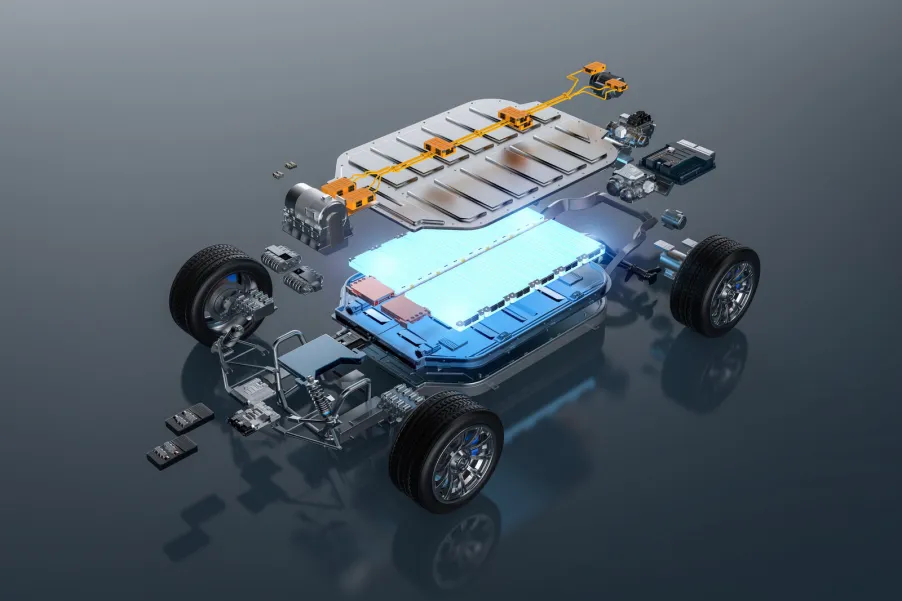
| Battery/energy | Fuel tank (liquid hydrocarbons) | Large traction battery + high-voltage system changes post-hit hazards |
| Sensor signatures | Well-modeled by legacy data | Less-modeled; useful for seeker validation and countermeasure studies |
Sources for Cybertruck design attributes: Tesla public specs and reputable technical summaries.
Deeper context: Why test with a stainless-steel EV?
Threat realism. Test planners often mirror plausible target sets. If potential adversaries copy or import stainless-steel EV trucks—or field indigenous equivalents—the U.S. needs empirical data to calibrate seekers, aimpoints, and warhead settings. Edge-case validation is valuable: a material that dents, tears, or spalls differently can affect fragmentation, perforation paths, and the thermal/pressure environment around a battery pack or high-current cabling.
Sensor and fuze behavior. Stainless surfaces and planar facets could change radar cross-section or IR reflections, influencing terminal guidance and fuse arming logic. Testing also informs range safety and post-blast cleanup procedures specific to EVs (e.g., stranded energy in cells, thermal runaway risks).
Training realism. SOCOM and other units practice target ID and engagement under realistic conditions. Including unfamiliar shapes and materials in the “target zoo” pushes operators and autonomy stacks to generalize better.
Practical steps / checklist (for analysts tracking this procurement)
- Monitor contracting updates. Pre-solicitation and award notices on SAM.gov can change; subscribe to updates and check for amendments or brand-name justifications.
- Correlate range scheduling. White Sands public affairs and test center calendars sometimes signal upcoming events; cross-check with AFTC releases.
- Validate sensor/munition test lines. Look for language mentioning “standoff precision-guided munitions,” “seeker characterization,” or “lethality testing.” These typically indicate instrumented events.
- Follow reputable defense outlets. Defense-focused publications tend to surface contracting rationales and test photos quickly.
- Note EV-specific safety protocols. Expect unique range-safety and post-test handling instructions for high-voltage systems. (Watch for updates in contract attachments.)
Common mistakes & how to avoid them
- Mistake: Assuming this is a fleet trial or operational buy.
Avoid it: The Cybertrucks are targets, not tactical trucks; the point is to study weapons effects, not to field EV pickups to units. - Mistake: Over-generalizing results to all EVs.
Avoid it: Stainless exoskeletons and 48V systems aren’t universal; other EVs use painted aluminum/steel and 12V low-voltage. Results will be platform-specific. - Mistake: Treating early contracting notes as final.
Avoid it: Pre-award documents are subject to change; quantities, vendors, and timelines often shift before test day. - Mistake: Ignoring range context.
Avoid it: White Sands specializes in PGM testing; background documents help anticipate instrumentation and data products.
FAQ
1) Is the Air Force really going to “blow up” the Cybertrucks?
Yes—these vehicles are test targets for precision-guided munition events. They will be instrumented and struck under controlled conditions to collect lethality and sensor data.
2) Why choose Tesla’s truck instead of any EV?
The stainless-steel exoskeleton and 48-volt architecture make it an outlier worth studying. These features could alter sensor returns and post-impact behavior relative to typical painted steel/aluminum trucks.
3) Where will tests occur?
At White Sands Missile Range in New Mexico, a long-standing venue for precision weapons trials and instrumentation-heavy data collection.
4) Does this mean the military plans to field Cybertrucks?
No. The documents and coverage describe a target-vehicle buy for test/training, not an operational acquisition program.
5) How does SOCOM fit into this?
Reporting ties the target set to scenarios supporting SOCOM training and realistic target representation for standoff munitions, ensuring operators and systems see diverse vehicle types.
6) What’s the connection to “standoff precision-guided munitions”?
Standoff PGMs let aircraft and drones engage from distance. These tests help validate seekers, aimpoints, and warhead settings against novel vehicle constructions.
7) Anything special about post-blast EV handling?
Yes. High-energy batteries create unique thermal-runaway and stranded-energy risks; range teams use tailored safety procedures and cooldown/monitoring protocols.
Related: Tesla Over Light Bar: 50″ Roof & 48V Buyer’s Guide (USA)
Conclusion
The Air Force’s plan to buy two Tesla Cybertrucks for explosive testing isn’t a stunt, it’s a data-driven way to future-proof weapons evaluations and operator training against vehicle types that don’t behave like yesterday’s targets. With stainless steel exteriors, novel 48-volt systems, and an EV thermal profile, Cybertrucks are useful outliers that help validate seekers, fuzes, and lethality models under realistic range conditions at White Sands Missile Range. As contracting steps progress, watch for schedule details and post-test reporting: those will ultimately show what mattered most to the test community and what the Pentagon learned from blowing up two of the most recognizable vehicles on U.S. roads.