Summary
This guide explains how EV fast chargers (a.k.a. DC fast charging/Level 3) work, what they cost, how long they take from 20–80%, and which connector CCS, CHAdeMO, or NACS (SAE J3400), you’ll actually use in the U.S. We combine hands-on observations with current standards and policies to help four audiences drivers and shoppers, fleet/rideshare operators, property owners (retail, hotels, workplaces), and municipal planners pick the right solution, faster and with fewer surprises. For transparency, we’ve included Who/How/Why details and authoritative sources.
What “EV fast charging” really means
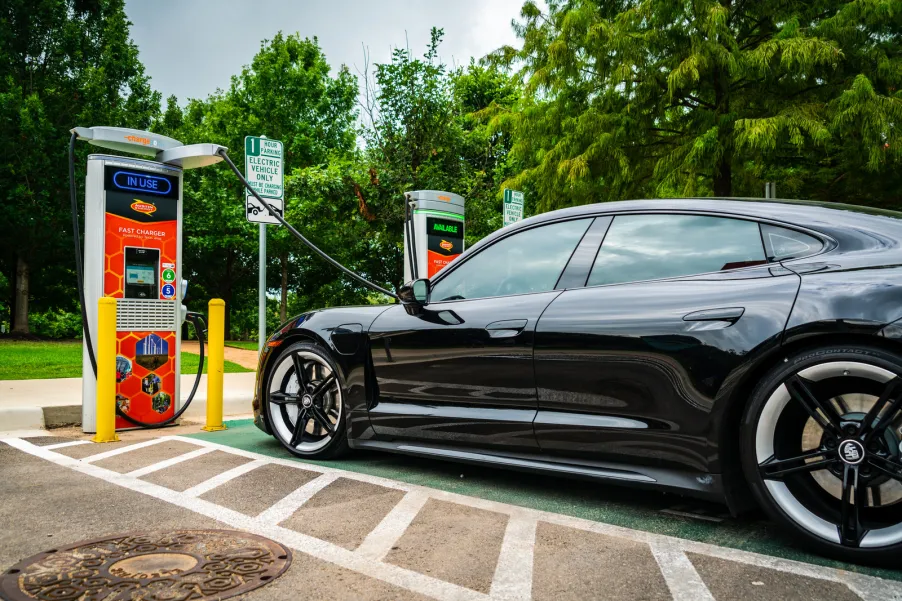
Level 3/DC fast charging delivers direct current (DC) power straight to the battery, bypassing the car’s onboard AC charger. In U.S. policy and consumer resources, it’s designed for quick turnarounds along highways and in high-throughput hubs; many systems can charge a BEV to about 80% in ~20–60 minutes, depending on the vehicle and the charger’s maximum kW output.
Government and industry references use “DC fast charging” interchangeably with “Level 3.” Typical public equipment in 2025 spans 50 kW to 350+ kW, with the NEVI program setting minimums for federally funded highway sites.
Important distinction: kW vs. kWh.
- kW = power (rate of charging).
- kWh = energy (battery capacity and energy added).
Charge time is a function of both the charger’s kW and your EV’s charge curve; the same 350 kW station won’t deliver 350 kW if your car tops out at 150–200 kW or tapers early. Independent tests routinely show faster early-session speeds and a slowdown approaching 80–90% to protect the battery.
Connectors: CCS vs. CHAdeMO vs. NACS (SAE J3400)
If you’re in the U.S., you’ll mostly encounter CCS and NACS (SAE J3400) at public DC fast sites; CHAdeMO support persists for a shrinking population of legacy vehicles. By late 2025, consumer advice for shoppers is clear: NACS ports and adapters are widespread or underway, with many 2026 models standardizing.
To reduce confusion, SAE formalized NACS as SAE J3400, and is actively publishing related materials in 2025 to harmonize North American charging. Expect more native J3400 (NACS) ports on new EVs and broader cross-network access.
Policy & reliability: what NEVI requires (and why it matters)
For highway corridors using federal funds, NEVI minimum standards require at least four DC fast-charging ports that can each deliver 150 kW simultaneously, along with rules on credit-card/contactless payment, data sharing, and 97% annual uptime targets codified in federal regulation. These provisions aim to make fast charging more consistent for drivers and easier to plan for fleets.
Real-world time from 20–80%
Why does everyone cite 20–80%? Because most EVs charge fastest in that middle band. Charging curves rise to a peak, hold for a bit, then taper as the pack fills. Staying in the sweet spot shortens stops and improves charger throughput—crucial for fleets and busy sites. Tests on new 800-volt platforms show how quickly energy can be added early in a session, then slow closer to full.
Costs: what drivers and site owners should know
Public DC fast charging is the most expensive way to refuel an EV, typically priced by $/kWh, $/minute, session fees, or hybrids thereof; major networks also add membership tiers. Big networks publish current rates in-app and at the charger because pricing varies with local power costs and the charger’s power level.
For directional context in 2025, consumer publications peg the average U.S. residential electricity price around 17–18¢/kWh in spring 2025 (home is cheapest; public DCFC is higher). Your actual public DCFC price can be several times the home rate depending on location and network. Always check live pricing before you plug in.
Comparison Table: Which charging fits your use case?
| Use case | Typical stop length | Best fit | Power (kW) | Real-world 20–80% | Notes |
|---|---|---|---|---|---|
| Road trips / corridor travel | 15–45 min | DC fast (Level 3) | 150–350+ | 20–40 min (vehicle-dependent) | Check connector (NACS/CCS), plan around peak rates and taper. |
| Urban hubs / rideshare staging | 15–60 min | DC fast | 100–200+ | 25–50 min | Throughput matters. Consider payment options and queuing. |
| Workplace / hotels | Hours | Level 2 + a few DC fast | 6–19 (L2) / 150–350 (DCFC) | N/A for L2 | L2 covers most dwell; DCFC adds premium convenience. |
| Retail/malls | 30–120 min | Mix (L2 + DCFC) | 6–19 / 150–350 | 20–60 min (DCFC) | Offer L2 for long dwell; DCFC for quick turnover. |
| Municipal/fleet depots | 20–90 min | High-power DCFC | 150–350 | 20–60 min | Plan for NEVI-like specs, payment, uptime, and expansion. |
How to choose an EV fast charger (by audience)
For EV owners and shoppers
- Connector: Verify your car’s native port (CCS or NACS) and adapter availability. Many 2025–2026 models are adopting NACS (SAE J3400).
- Peak charge rate: Your car’s max DC rate (kW) caps speed. Don’t pay for 350 kW if your car peaks at 150 kW. Check owner’s manual or trusted spec sheets.
- Plan in the 20–80% band for fastest travel days; jumping from 80–100% can easily double your stop time for marginal extra miles.
For fleet managers and rideshare
- Throughput > single-session speed. Four 150 kW ports that actually deliver power simultaneously reduce queues better than one 350 kW plug. That’s one reason NEVI codified per-port delivery requirements.
- Payment and authentication: Favor sites with contactless cards and Plug & Charge (ISO 15118) to reduce failed starts and speed turnover.
- Data & reporting: Look for networks that expose session data (kWh, time, cost) to feed your TCO models and driver compliance.
For property owners (retail, plazas, hotels, workplaces)
- Right-size the mix: Pair Level 2 for long-dwell parking with a few DC fast ports for premium convenience and incremental revenue/footfall.
- Compliance & incentives: If you’re near a highway corridor, ensure your design meets (or anticipates) NEVI and buy-America rules to unlock funding and procurement options. Plan for 97% uptime with robust O&M.
- Pricing strategy: Decide early between kWh, time-based, and session models (as allowed by state rules). Check how major networks present pricing to drivers in-app and at the charger.
For municipal planners & sustainability teams
- Equity & access: Co-locate DCFC where drivers actually live and work, not just at highway exits.
- Uptime enforcement: Bake >97% annual uptime and responsive maintenance SLAs into contracts.
- Future-proofing: Include conduits for higher future power (e.g., 350 kW cabinets), J3400 readiness, and ISO 15118 capabilities.
Practical steps / checklist
- Confirm your connector path: Native NACS (SAE J3400), CCS, or adapter? Align purchasing with your fleet/driver mix.
- Set power targets: For highway or high-throughput sites, design around ≥150 kW per port simultaneously with at least four ports; add more if dwell is short.
- Model TCO: Combine hardware, make-ready (utility upgrades), demand charges, networking, and O&M. (Public DCFC is pricier than home; shop tariffs and load management.)
- Enable easy payments: Require contactless credit plus Plug & Charge (ISO 15118) to cut start-failure rates and speed turnover.
- Design for uptime: Choose hardware and service partners willing to commit to >97% uptime, with clear response times and spare-parts plans.
- Plan the driver experience: Lighting, wayfinding, pull-through bays for trailers, weather protection, and clear pricing on screens and in apps.
- Communicate charge curve reality: Signage or app tips that 20–80% is fastest; discourage squatting at 99% with idle fees where allowed.
Common mistakes & how to avoid them
- Mistake: Buying the biggest single charger instead of multiple simultaneous 150 kW ports.
Fix: Throughput and queue reduction usually beat a single headline number; spec per-port delivery as NEVI does. - Mistake: Ignoring authentication and payment UX.
Fix: Support contactless plus ISO 15118 Plug & Charge; fewer failed sessions, happier drivers. - Mistake: Overlooking taper.
Fix: Educate users and design pricing/idle fees to encourage 20–80% sessions and higher turnover. - Mistake: Skipping reliability contracts.
Fix: Bake >97% uptime and preventative maintenance into agreements. - Mistake: Under-provisioning power and conduits for future upgrades.
Fix: Pre-wire for additional cabinets and J3400/NACS expansion.
FAQ
1) What’s the difference between kW and kWh—and why does it matter for fast charging?
kW is charging speed (power), kWh is energy added. A 150 kW car won’t charge faster just because a 350 kW plug is available; the car’s charge curve limits real-world speed and tapers as you approach full.
2) How long will a 20–80% DC fast charge take?
Most modern EVs hit 20–40 minutes in good conditions, but vehicle design (400 V vs 800 V), peak acceptance, and battery temperature all matter; curves slow near 80–90%.
3) Which connector should I choose in the U.S.?
NACS (SAE J3400) is rapidly becoming standard on new models, with CCS still widely supported; CHAdeMO is fading. Verify port, adapter availability, and network access for your routes.
4) What are the NEVI “minimums” I should know?
Federally funded corridor sites need ≥4 DCFC ports, each able to deliver 150 kW simultaneously, with rules for open payments and >97% uptime.
5) Is public DC fast charging more expensive than home?
Usually yes. Networks price by kWh and/or time, plus fees. U.S. average home electricity was ~17–18¢/kWh in spring 2025, while public DCFC often costs more. Always check the live price in the app/charger screen.
6) What is Plug & Charge—and do I need it?
It’s an ISO 15118 feature that lets the car handle authentication and billing automatically when you plug in—less friction for drivers and faster turns for fleets. It’s increasingly supported across EVs and chargers.
7) Do PHEVs use DC fast charging?
Most PHEVs don’t support DCFC; they’re typically limited to AC charging. If fast turnarounds matter, verify your specific model.
Related: Tesla Cybertruck: Specs, Price, Range, Towing, And Real-World Buying Advice
Conclusion
Whether you’re picking your first EV, managing a rideshare fleet, scoping a retail-site install, or planning a city’s corridor hubs, EV fast chargers boil down to a few durable principles:
- Connector clarity (NACS/J3400 rising, CCS still common; CHAdeMO fading in U.S.),
- Throughput over peak bragging rights (≥150 kW per port and enough stalls),
- User-friendly payments (contactless + Plug & Charge), and
- Honest charge-curve expectations (20–80% is your time-saver).
Use the checklists above, align with NEVI reliability standards, and verify live pricing before you plug in. That’s how drivers get back on the road faster—and how site owners build charging that actually works.